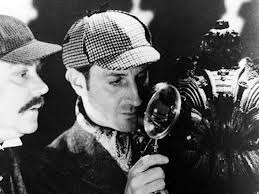
 While in a debate recently, one chap justified his assertion by deploying the following quote …
“When you dismiss the impossible, whatever you have left, however improbable, is the answer.”
Recognise it? Yep, Sherlock Holmes (or Spock if you prefer), well the precise quote is this …
“You will not apply my precept,” he said, shaking his head. “How often have I said to you that when you have eliminated the impossible, whatever remains, however improbable, must be the truth? We know that he did not come through the door, the window, or the chimney. We also know that he could not have been concealed in the room, as there is no concealment possible. When, then, did he come?”
The Sign of the Four, ch. 6 (1890) Sherlock Holmes in The Sign of the Four (Doubleday p. 111)
It sounds great, but quoting a fictious character to justify a logical stance should set alarm bells ringing. Since this quote is so well-known, lets take a brief look at it.
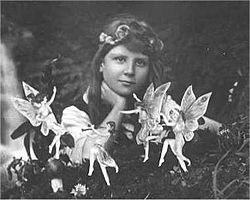 First, was Arthur Conan Doyle a good logical thinker? Not really, this is the same guy who was conned by a couple of teenage girls into thinking that Fairies were real.
Looking at the famous Cottingley fairies picture on the right you can clearly see that all the girls did was cutout a few cardboard figures. That was the immediate conclusion of the family, but unfortunately the pictures got into circulation and eventually Conan Doyle heard about them and was totally convinced they were real, even going as far as writing stuff like this …
My heart was gladdened when out here in far Australia I had your note and the three wonderful pictures which are confirmatory of our published results. When our fairies are admitted other psychic phenomena will find a more ready acceptance … We have had continued messages at seances for some time that a visible sign was coming through
(You can insert your face-palm here)
Anyway, what I’m trying to tell you is that the famous and often quoted phrase clearly did not work for the author himself. Why not? Well because it contains a couple of logical fallacies.
Have you truly eliminated all other options as “impossible”. If you have one last thing that is improbable, them there are a lot of possibilities here, and this last improbable conclusion should not be simply accepted. While it should of course be given due consideration, what about the following …
- Are all the other options truly “impossible”? In the case of fairies, why eliminate the possibility of fraud as “impossible” when that is the most probable
- Perhaps the very premise itself is wrong
- In fact have you truly eliminated all other possibilities, is it not more possible that there is a simpler alternative that you have not yet considered?
Sherlock Holmes may indeed be great fiction, but in the real world, the ability to posit a long string of events perfectly is more likely to lead one to a false conclusion.
Don’t lean upon the flawed logic of fictional characters, if you do then you may indeed end up embracing complete fiction as fact.
To believe you might actually find the full truth of everything – is flawed. You can’t reasonably debate someone’s mental health as evidence something is correct or not or argue someone’s full beliefs…It is not possible you enter their mind to know exactly their thoughts or to suppose anything??Mearly opinion. You have no sense of humour… fairies could be are tongue in cheek, or they could be real… ;-) as nothing to disprove. Have you ever seen them? There is a truth in what you don’t know… Ask yourself this…
how do you not know what life exists beyond your own ideals? Belief? Reasoning perhaps?
The underlying truth is it is impossible for us to know everything… Quite magical ;-) Possibly what you believe is a choice… It is true this statement…. a very good one. Only time tells. You may await a very long time in some cases to know the full truth, yet your mind & where it directs you to possibilities is extremely influential… :-)
By claiming that Faeries don’t exist one can only prove his ill ways of thinking. You can deal with what you meet. Otherwise you simply don’t know. If the subject interests you – pursue it. If not, stop thinking about it. You can only meet what exists. All that thinking like “it’s impossible, people can’t do that, they don’t exist” is based on lazy thinking that you can know for sure and that you know everything about the subject there is to know. Few years ago I thought that some things are impossible – and now I know that the world is different. I wouldn’t be surprised if I would meet a faerie one day – that’s how much my view on the world has changed. Because I was wrong and the truth shattered my old views.
Probability has two huge flaws. 1. It is subjective. 2. It is only a reflection of environment.
A man in a world without advanced technology (more than spears, bows and horses) but with magic and magical creatures (I’m calling it “magic” but for them it would be normal like technology to us.) This man would have a lot different view of what is probable and what is not. Even our Sherlock Holmes’ reasoning would be thrown out to trash with all our modern technology used in committing a crime. Then Sherlock would rule out “impossible” which is actually possible. And he would cut off himself from the truth entirely on the mind level until he would be proven wrong.
“We know that he did not come through the door, the window, or the chimney. We also know that he could not have been concealed in the room, as there is no concealment possible.” – with “magic” or very advanced technology it would be possible. He is assuming that he knows everything about what is possible and what is not in this case while he even doesn’t really know who did it. To know a man you must invest a lot of time in learning him. And yet he is assuming that he is dealing with someone simple and predictable while he can’t even identify this person. He is dealing with marks that were left – nothing more.The person he is thinking about is abstract. Made up by his imagination and lacking any real insight. You can’t judge boar’s personality, fur color, sound of his voice by marks left in the ground. You won’t distinguish a wild boar from a trained one just by it if they will just run looking for food. You might assume what I drink if you will look inside my fridge but it is worthless if you don’t know that I don’t use it and I let my friends leave there their stuffs. You might assume that I’m bald if you will look at photographs in my house. But I’m not. They were just false photos for fun. So little time, so few marks – so little data… This is like a guessing game. It is nothing without verification. And just because evidences point at someone it doesn’t mean the person is guilty. That person could be framed by a forgery master.
“Few years ago I thought that some things are impossible– and now I know that the world is different”
Is it possible to draw a triangle with four sides?
Can you start a fire in a totally oxygen-free environment?
Conan Doyle based Holmes on a Univ. of Edinburgh medical school professor, Dr. Joseph Bell. Dr. Bell was renowned for his logical reasoning. Many ideas expressed by Holmes actually came from Bell.
There is no evidence Dr. Bell believed in fairies, even if Conan Doyle did.
Also . . .
By the time the “photographs” reached A.C.D. we do not know how they looked or how many times they had been reproduced. Given that the technology of the day in photographic reproduction especially in newspapers and similar media such as circulars. Did he ever see the original photographs? Can Dave uniquivily say that the “obvious fake photographs” that he saw and reposted have never been photoshopped??
A couple of things to consider . . .
Meanwhile I have read all of the Sherlock Holmes stories
Doyle’s comments about eliminating the impossible seems plausible. He did not say everything else was plausible or highly likely, simply that it was not impossible. Re: the discussion of fairies, an old legal maxim seems very applicable, “Absence of evidence is not evidence of absence.” While I have no reason to conclude that fairies exist, I am unable to offer incontrovertible proof they do not.
One cannot know whether or not fairies are real. Why do you assume they are not? Because you cannot see them? What about the people that can, those assumed crazy? Weren’t people called crazy if they believed that the earth was round and not flat just a few centuries ago? Back when there was no photoshop a photo was pretty concrete proof. So, then, Conan Doyle wasn’t so far off as you’ve labeled him to be. In addition, the job is not to eliminate possibility, the job is to eliminate IMPOSSIBILITIES. Once that is done then whatever remains is true. Does that mean that EVERYTHING that remains must be true? No. But from what remains, after the impossible has been ruled out, the truth will be within. It is up to you to string together the most coherent truth.
“Weren’t people called crazy if they believed that the earth was round and not flat just a few centuries ago?”
No, they weren’t; we’ve known the world was spherical since ancient times: https://en.wikipedia.org/wiki/Myth_of_the_flat_Earth
Clearly you are trolling mikiestar, Doyle believed that fairies were real. Criticism of that daft belief is wholly appropriate … or do you also assert that fairies are real?
Your own arguent is flawed. You include a character attack. First indicator of a bullshitter.